- Find one (1) headline you recently encountered that you felt was effective.
a) Provide the exact headline
b) Explain why it resonated with you
c) Tie your explanation directly to specific headline elements discussed in class
Article Link: https://www.buzzfeed.com/daves4/funny-pictures-taken-a-the-perfect-time-march-2-2026
Article Screenshot:
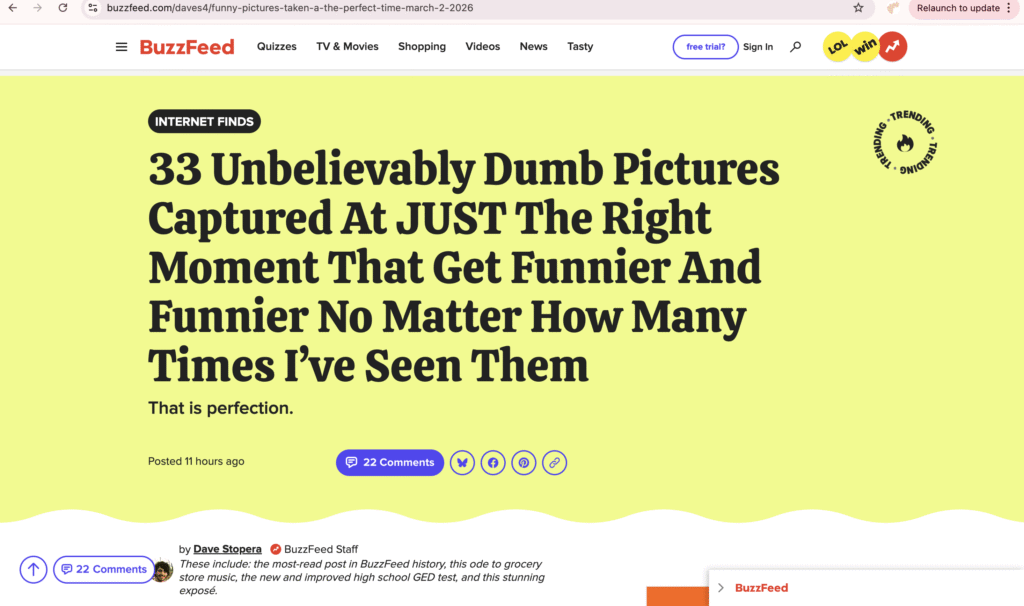
For this question, I have sourced my headline from a website that we are consistently referring back to in class for examples of “good headlines”, Buzzfeed. The specific headline which I have chosen to discuss is “33 Unbelievably Dumb Pictures Captured At JUST The Right Moment That Gets Funnier And Funnier No Matter How Many Times I’ve Seen Them”. There are several reasons as to why this headline was effective and resonated with me, the first being one which we have discussed in class a couple times which is the fact that an odd number of “33” is used. This is significant as such a number use is intentional and meant to grab the attention of potential readers and make the content itself within the article seem much more credible and trustworthy while also leveraging the known psychology behind specificity bias. The reason for this is that this number is very specific, it’s not just a word like a “bunch” or an even number like 10, no it feels as though there is a reduction in uncertainty because readers can know exactly how much content they are being given and that there was not just irrelevant content of lesser value to them added to make the number an even one like 10 for example. In addition to this, the odd number of 33 is also just going to stand out among the text, purely because it is more unexpected and visually distinct in comparison to numbers that feel more manufactured to people. To illustrate this further, the Go Braithwaite marketing agency cites that “headlines with odd numbers garnered 20% more clicks than those with even digits”. This is important to know as it proves the point of how 33 is an oddly specific number that makes this headline more effective and also helped it to resonate further with someone such as myself who noticed this article stand out in particular due to the inclusion of this number.
Another clear reason as to why this was a headline that I felt was so effective and resonated with personally was the fact that it was able to clearly match my user intent on Buzzfeed’s website. Generally speaking, when people are choosing to visit Buzzfeed for some content, they are in search of articles that seem to be more lighthearted and entertaining as opposed to seeming more deep, academic and serious. Therefore, this headline in particular is helping to effectively be able to signal that this article is one that uses humor and will provide some instant gratification to the readers who are likely in search of this through appealing to people’s relevance bias. This was done by using words such as “Dumb” or “Funnier” in the headline itself. This headline also heavily aligns with use intent generally speaking as it matches very well with Buzzfeed’s typical tone and voice as it relates to funny yet relatable content that features headlines that are intended to make the content seem “viral” or very popular. Overall, when a headline like this is so well aligned with user intent, it provides the benefit of reducing the uncertainty that readers might have and it also signals to readers that the article content is relevant to them. So, essentially by being able to match this headline to the typical user intent, Buzzfeed has successfully been able to create headlines that reflect what users generally expect from a Buzzfeed article which increases the likelihood of them choosing to actually read the article.
Alongside all of this, the headline is also incredibly effective and resonated with me because of hope it instantly was able to trigger my curiosity. The way in which Buzzfeed was so easily able to do this was through their usage of this sentence “Unbelievably Dumb Pictures Captured At JUST The Right Moment”. This wording in particular is able to effectively capture my curiosity as it makes people like myself seeing the headline for the first time think about all the questions that we could potentially have in regard to what the content in the article actually is. For example, some questions that I personally had were “what moment?”, “wait what happened?” and “what was just the right moment?”. I wanted to know what the “dumb pictures” the headline mentioned were and I also wanted to understand what the perfect timing of these photos was and how it made them so funny. Therefore this headline was trying to provide me with a curiosity gap that reading the article’s content could fulfil which is one of the many reasons why this headline was so effective and resonated with me as a potential reader.
RESOURCES:
1.Stopera, D. (2026, March 2). 33 unbelievably dumb pictures captured at just the right moment that get funnier and funnier no matter how many times I’ve seen them. BuzzFeed. https://www.buzzfeed.com/daves4/funny-pictures-taken-a-the-perfect-time-march-2-2026
2.Airwin@Gobraithwaite.com. (2022, March 21). The odd thing about odd numbers. Braithwaite Communications. https://gobraithwaite.com/thinking/the-odd-thing-about-odd-numbers/
Leave a Reply